
- Home
- /
- Industries
- /
- Senior Living
Water Management and Legionella Control for Senior Living
Water safety designed for residential buildings that house a clinically vulnerable population
Senior living communities house the population most susceptible to fatal outcomes from Legionnaires’ disease and other conditions caused by waterborne pathogens. But most of them fall outside the federal water management requirement.
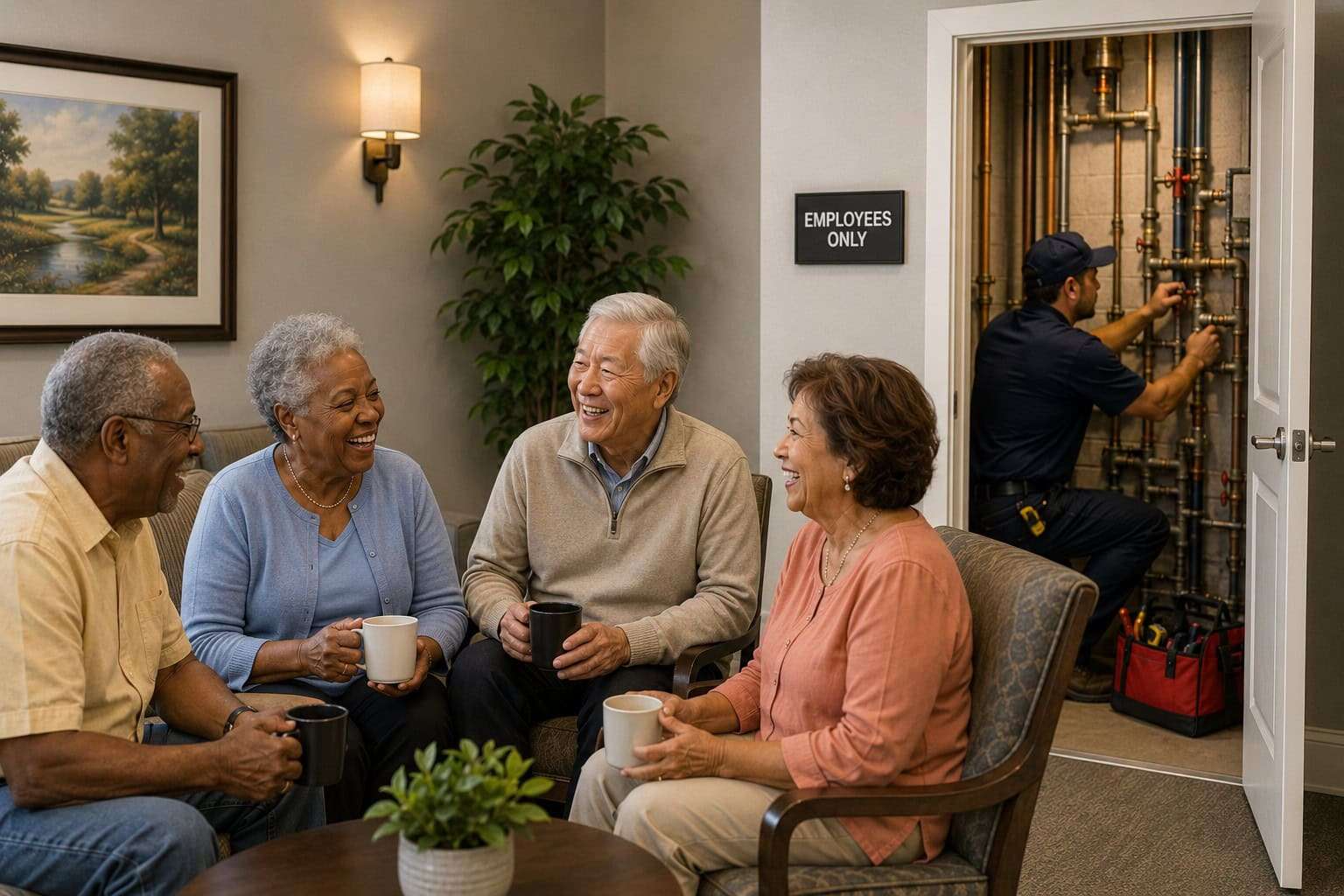
If you operate skilled nursing, CMS expectations apply through infection control. If you operate assisted living, independent living or memory care, your obligation comes from state law, your accreditor, your insurer, or an attorney – not a federal surveyor.
LiquiTech helps you build and maintain a program that holds up to all of the above. Get the experienced, expert help you need to establish measurable control, document it defensibly, and extend the life of your aging plumbing infrastructure. Respond in days when a positive result arrives, across a single community or an entire network of sites.
3 Senior Living Water Treatment Challenges
The water challenges facing senior living
Your residents carry the same risk profile as hospital populations
Assisted living is licensed as a residential, non-clinical setting. But its residents are not a typical residential population. Case fatality in CDC’s “assisted or senior living” exposure category was 18.2% in 2020 and 12.3% in 2021 — against roughly 10% across all cases (CDC Legionnaires’ Disease Surveillance Report, 2020–2021). That is not because these buildings are worse. It is because Legionnaires’, pneumonia, and other conditions associated with waterborne pathogens are far less survivable in an older, sicker population.
Your building is aging and flushing wears off
Nearly half of senior housing inventory was built before 2000. Old infrastructure is more susceptible to dead legs, stagnation and other factors that accelerate bacterial growth. Flushing is the most common control measure, but peer-reviewed evidence shows that while flushing can quickly restore disinfectant residual and cut bacterial positivity levels, residual dissipates and bacteria rebounds to near pre-flush concentrations, often in just days (Hozalski et al., Environmental Science & Technology, 2020).
Staff turnover can invalidate your water management plan
Total senior living turnover was 35% in 2026. Maintenance = 24%, housekeeping and environmental services = 27% (Ziegler CFO Hotline, July 2026). A water management program that depends on one person remembering a flushing schedule and initialing a log is a program with a one-in-four annual failure rate. Even without turnover, the effort and expertise required to implement an effective water management plan places yet another strain on your already overstretched Facilities team.
CDC risk factors vs. Your residents
| CDC Legionnaires' risk factor | U.S. residential care residents |
|---|---|
| Age 50 or older | 94% are 65 or older - 53% are 85 or older |
| Chronic lung disease (COPD, emphysema) | 16.4% have COPD |
| Diabetes | 16.0% have diabetes |
| Cancer | 6.1% have cancer |
Sources: CDC, Legionella — Causes and Transmission (June 9, 2025) · CDC/NCHS Data Brief 506, Residential Care Community Residents, 2022 (Aug 7, 2024) · CDC, Legionnaires’ Disease Surveillance Report, 2020–2021. Resident data are from the 2022 National Post-acute and Long-term Care Study (NPALS); smoking history, kidney failure, liver failure and immune status are not collected in that survey.
LIQUITECH SYSTEM APPROACH
Water treatment specific for senior living
For senior living organizations, water treatment often means a municipal-style chemical program that was never designed for a residential building, or else a binder that documents a problem without changing it.
LiquiTech’s multi-patented solution is purpose-built for building water systems: continuous disinfection that works where risk actually lives.
Protection at the tap for your highest-risk residents, sediment removal upstream, and monitoring that generate accurate, timely documentation so your staff does not have to.
Achieve performance, not just compliance
Compliance asks whether you have a plan. Performance asks whether the water in the building is under control and whether you can demonstrate it.
With help from LiquiTech, you can define measurable control at the point of use, document it continuously, and give you the record you need to defend it.
Multi-Barrier Protection
How our multi-barrier water treatment solution integrates into senior living
No single technology controls a building water system. LiquiTech combines complementary barriers — immediate protection where residents are exposed, continuous disinfection through the distribution system, upstream sediment removal, and monitoring that verifies all of it.
Sediment and Point-of-Use Filtration
Removes 97% of suspended particulate matter at the point of entry, keeping water clear for residents and helping the building’s disinfection barriers work effectively where it matters most.
Copper-Silver Ionization
Fast, longer-lasting disinfection against Legionella and other waterborne pathogens, including the low-flow branches and dead-legs where episodic flushing can fail. No handling and storage of toxic chemicals that break down into known carcinogen required.
UV Disinfection
Chemical-free kill of 99.9999% of bacteria associated with waterborne pathogens at the point where municipal water enters the building, strengthening disinfection and biofilm prevention.
Smart Sensors and Water Intelligence Platform
Get earlier visibility into chemistry drift, microbial risk, and system performance trends. Replace periodic manual sampling with non-invasive, location-specific sensors feeding real-time water quality data to a dedicated software platform for dashboarding and analysis.
Mobile Disinfection
On-demand copper-silver ionization on a mobile platform, optimized for your site and shipped in about a week, with no permanent system and no long-term commitment
Ongoing monitoring and maintenance
Comprehensive ongoing monitoring and maintenance services for senior living, ensuring optimal performance and reliability. Our proactive approach helps identify and address potential issues before they impact operations.
Common Questions
Frequently asked questions about our water treatment products
Facilities across healthcare, hospitality education, and commercial sectors trust LiquiTech to eliminate Legionella and waterborne pathogens. Here’s how we deliver sustained results where other treatments fail.
No. CMS requirements apply to Medicare and Medicaid-certified providers. Skilled nursing facilities are certified under 42 CFR Part 483 and are subject to infection control expectations that surveyors apply to water management under tag F880. Assisted living, independent living and personal care communities are licensed by states and are not CMS-certified provider types, so the federal expectation does not reach them. Obligations for those settings come from state law, accreditation, insurance underwriting, or liability exposure.
It depends on where you operate and what you are licensed as. CMS explicitly does not require Legionella cultures and leaves testing protocols to the provider’s discretion. Several states do require testing or a sampling plan — New York for hospitals and residential health care facilities, and New Jersey for a broader set including assisted living. Absent a state requirement, testing frequency is set by your own risk assessment and control limits.
In a senior living community, accountability sits with the licensed operator, but execution is typically split between the Executive Director, plant operations or maintenance, and infection prevention. State corrective action plans commonly assign responsibility jointly to the administrator and maintenance director with an infection prevention consultant involved. A defensible program names a single accountable owner and documents the participation of the others.
There is no single federally mandated interval for senior living. Frequency should follow your written risk assessment, the control limits in your water management program, and any applicable state rule. New York requires sampling at intervals not exceeding 90 days in the first year for covered facilities, then annually. Where no rule applies, quarterly sampling of a defined set of distal sites is a common starting point that should be justified by your own risk analysis.
A water management program is a documented, building-specific plan to identify where waterborne pathogens could grow and spread in a water system and to control those conditions. Core elements are a designated team, a description and flow diagram of the water system, a risk analysis, defined control measures with acceptable ranges, monitoring, corrective action procedures, verification and validation, and documentation. CDC and CMS use the word “program”; ASHRAE 188 and most state statutes say “plan.” The terms are used interchangeably.
There is no single federally mandated interval for senior living. Frequency should follow your written risk assessment, the control limits in your water management program, and any applicable state rule. New York requires sampling at intervals not exceeding 90 days in the first year for covered facilities, then annually. Where no rule applies, quarterly sampling of a defined set of distal sites is a common starting point that should be justified by your own risk analysis.
ASHRAE Standard 188 is a consensus standard, not a law. It becomes a requirement when a regulation, accreditor or contract adopts it. New Jersey’s P.L.2024 c.66 requires a water management plan consistent with ASHRAE 188-2018, and Michigan reaches it through healthcare licensure. It is also the benchmark insurers use when underwriting. ASHRAE Standard 514-2023 now addresses microbial, chemical and scalding hazards in a single framework and is worth understanding alongside 188.
Requirements vary by state and by license type. New Jersey, Ohio, New York, Michigan and South Dakota all impose obligations that reach some senior living settings; New Jersey and Ohio name assisted living or residential care facilities explicitly. New York’s healthcare rule does not extend to adult care facilities. See the state table above for scope and dates.
Yes. New Jersey P.L.2024 c.66, the Senate Committee Substitute for S2188, names nursing homes, assisted living facilities and related residential care facilities, and separately covers senior housing with 25 or more units on shared centralized water heating. Plans must be consistent with ASHRAE 188-2018, records retained five years, with penalties escalating from $2,000 to $10,000. Development is due September 12, 2026 and implementation December 12, 2026.
CDC does not set a universal testing mandate. Its guidance is built around the water management program: identify risk, establish control measures with acceptable ranges, monitor them, and act when limits are exceeded. CDC’s Toolkit: Developing a Water Management Program to Reduce Legionella Growth and Spread in Buildings is the operative reference, and includes considerations for healthcare settings.
Senior Living Resources
Related content for senior living professionals

5 Questions to Ask Before Choosing a Water Treatment Vendor
Senior living buildings are not small hospitals and they are not ordinary apartment buildings. This guide covers what to ask about performance standards, water chemistry, infrastructure impact, and what a vendor should be able to document.